
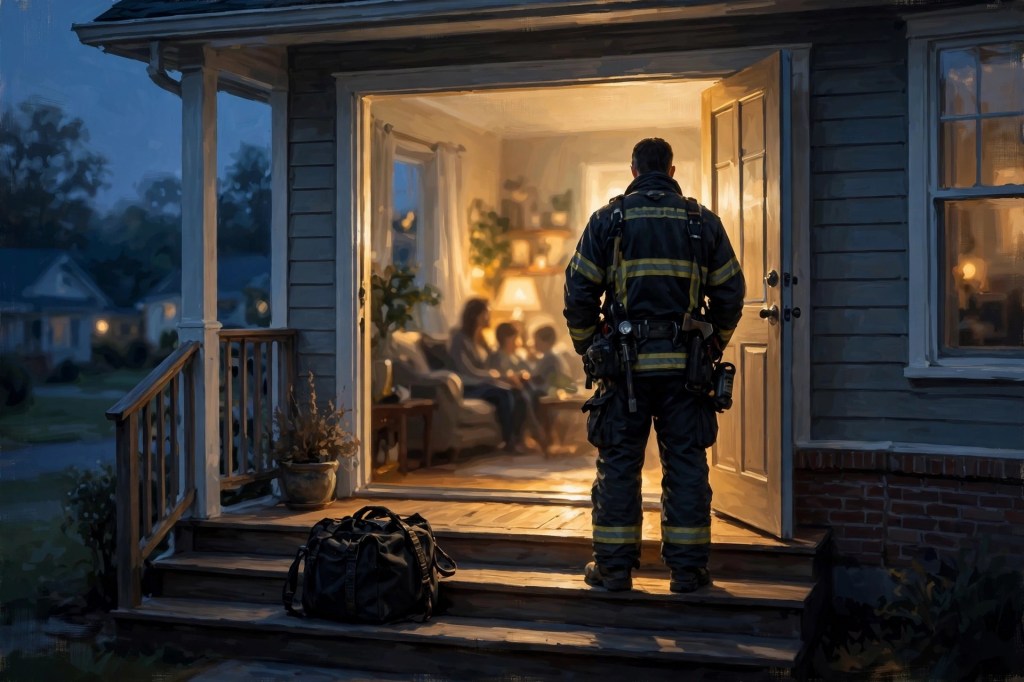
By Noelle Dodge | October 7, 2026 | A World of Wonder Press
First responders are trained to be calm in the worst moments of other people’s lives. The research is clear about what happens when they carry those moments home — and who pays for it.
By Noelle Dodge
October 2026 · A World of Wonder Press
The call ends. The gear comes off. The report gets filed. Then a police officer, a firefighter, an EMT, or an ER nurse walks through the front door — and the hardest part of the day begins for somebody else.
For decades, we have measured the toll of traumatic work in the person who does the job: burnout, post-traumatic stress, drinking to cope, suicide. But a growing body of research asks a different question — what happens to the spouse listening in the hallway, and the children who learn to read a parent’s mood before they can read a book?
The answer is consistent, and it is not subtle. Trauma does not stay contained in the individual who witnessed it. It ripples outward — through a marriage, into children, across generations — unless somebody names it and intervenes early. First responder families, who live beside that exposure every single day, are among the most affected and the least seen.
The Family Is Not a Bystander
One foundational study followed children of first responders after two very different exposures: the September 11 attacks in New York City — a single, rare mass-violent event — and daily exposure to repeated mass violence in Tel Aviv. In New York, children of responders who were highly exposed at the World Trade Center had markedly higher rates of mental-health problems than children whose parents were not. Children of EMTs showed the highest rate of PTSD among responder children — 18.9 percent — followed by children of police officers at 10.6 percent.
That gap matters more than the absolute numbers. The EMTs’ children were not at Ground Zero. Their parents were. What traveled home was exposure by proxy: the retelling, the silence, the hypervigilance at the dinner table, the parent who was physically present and emotionally somewhere else. For children in Tel Aviv, where exposure was not rare but routine, the pattern compounded. Prior exposure, the researchers noted, increases the probability of developing PTSD after the next one. There is no acclimation. There is accumulation.
18.9% of children of EMTs in the WTC study met criteria for PTSD — higher than any other responder group, though none of them were at the site.
Drinking to Cope Is a Unit Problem, Not Just a Personal One
Fire service culture has long framed drinking as an individual choice. A 2008 study in the Journal of Applied Psychology challenged that directly. Researchers surveyed 1,481 firefighters across 144 companies and modeled how unit-level resources — adequate staffing, functioning equipment, supportive leadership — shaped individual responses to critical-incident involvement.
The finding was stark: when the unit’s resources were inadequate, firefighters were significantly more vulnerable to drinking to cope with distress, and to the downstream consequences of that coping. When resources were sufficient, that vulnerability dropped. In other words, the firehouse that sends its people into trauma without adequate support is not just risking burnout on shift — it is exporting the consequences into the firefighter’s marriage and onto the children watching from the couch. Support the responder, you reduce the secondary trauma at home. That connection runs in both directions.
Spouses Absorb Stress — And Sometimes Violence
If children absorb trauma by proximity, spouses absorb it by partnership. A 2014 prospective study tracked police officers and their spouse/partners repeatedly over time to establish direction: whose distress precedes whose?
Partners, the study found, develop secondary traumatic stress in direct association with the officer’s PTSD symptoms — and that partner stress was significantly linked to couple violence in both directions. Compassion fatigue, the researchers suggest, is not abstract “burn-out.” It is a specific form of secondary trauma that corrodes the very relationship the responder needs most to recover.
The broader data point is one the National Center for Women and Policing surfaced years ago and the field has never fully metabolized: domestic violence is two to four times more common in police families than in the general population. That is not an indictment of individual officers. It is what happens when a profession trains people to compartmentalize emotion under pressure, brings that compartmentalization home nightly, and then makes seeking help a career risk.
“The expectation of a first responder is to be unaffected, calm and solution-focused — which adds more pressure to finding solutions outside their community.”
The Lethal Edge
Untreated trauma does not just strain families. It kills. Analysts at NIOSH, working from Bureau of Labor Statistics and CDC data spanning 2003 to 2010, found that protective services workers — police officers among them — died by suicide at 5.3 per million workers, more than three times the workplace average. Police officers and doctors had the highest suicide rates of any occupation studied, a link researchers attribute in part to lethal-means access — weapons and narcotics — layered on top of relentless job stress.
That statistic sits behind every responder family’s unspoken anxiety. Lose the emotional support of a partner to secondary trauma and the financial support to suicide or disability in quick succession, and a family can slide into the very systems — child welfare, benefits, courts — that its own member was employed to administer. Dependency, in that context, is not empowerment. It is a transfer of control from one pressured system to another.
Why Shame Is the Lock on the Door
If the data explains what happens to responder families, shame explains why so many of them never get help. In first responder culture, perceived weakness invites shame — and shame, as researcher Brené Brown articulated in Shame Resilience Theory, is the difference between “I did a bad thing” (guilt) and “I am bad” (shame). Guilt can motivate change. Shame shuts people down.
Brown’s grounded-theory work identified what traps people — disproportionately women, though the mechanism is universal — in what she called a shame web: interlocking feelings of powerlessness, being trapped between contradictory expectations, and isolation. Each layer reinforces the others. A firefighter’s wife who is struggling is also a mother who is supposed to hold it together, an employee who is supposed to perform, a partner who is not supposed to “stress him out more.” Every expectation carries a penalty. Every option is wrong.
The way out, Brown found, is not private endurance. It is speaking shame — naming it in safe, facilitated settings where the experience is met with empathy rather than judgment. That is the theoretical core of trauma-informed, shame-resilience work: teach people to recognize shame when it triggers, understand it as a psycho-social-cultural construct rather than a personal defect, and build the relational connections that make powerlessness interruptible.
Guilt says, “I did a bad thing.” Shame says, “I am bad.” Only one of those can be acted on. The other just gets hidden.
What Healing Actually Looks Like
None of this research argues that responder families are doomed. It argues that they are unsupported — and that support, when it is actually offered, works. Adequate unit-level resources reduced firefighter maladaptive coping. Partner-inclusive programming acknowledges that secondary trauma runs through relationships, not just individuals. Shame-resilience education gives families language for experiences they have only had silence for.
The direction is away from a prescription-first, pathology-first model toward conscious living, trauma-informed education, and community-level prevention: programs that equip parents rather than shame them, protect children rather than punish them, and treat the family as the unit of care. Proverbs put it in a line that outlasts every study: a united couple makes a united family. The research, it turns out, agrees.
Go Deeper
This article distills research that sits at the heart of two books now in development at A World of Wonder Press.
• Who’s Coming to Save Us? — a book-length examination of first responder families: the WTC responder-children study, firefighter coping research, police spouse secondary trauma, and the domestic violence and suicide data that frames them. If you want the full evidence — the studies, the numbers, the methodology — this is where the thesis becomes a book.
• Break Out Not Down — a personal work on shame resilience and the scapegoat dynamic. Where Who’s Coming to Save Us? maps the research, Break Out Not Down picks up the mechanism — shame as the lock, speaking shame as the key — and asks how families break the pattern rather than break down inside it.
The article is the doorway. The books are the rooms. If your household keeps someone else’s worst day on its kitchen table, there is a welcome mat at both doors.
References
• Brown, B. (2006). Shame Resilience Theory: A Grounded Theory Study on Women and Shame. Families in Society, 87(1), 43–52.
• Fairbrother, G., Stuber, J., Galea, S., Fleischman, A. R., & Pfefferbaum, B. (2003). Posttraumatic Stress Reactions in New York City Children Following September 11. Ambulatory Pediatrics. (WTC evacuee / first responder family exposure framework.)
• Harel-Fisch, Y., et al. Parental Exposure to Mass Violence and Child Mental Health: The First Responder and WTC Evacuee Study. (2-site longitudinal study, NYC and Tel Aviv.).
• National Center for Women and Policing. Police Family Violence Fact Sheet. (Domestic violence 2–4× more common in police families.)
• National Institute for Occupational Safety and Health (NIOSH). Analysis of BLS/Census of Fatal Occupational Injuries and CDC data, 2003–2010. (Protective services suicide rate 5.3 per million workers.)
• Prospective study of police officer spouse/partners: A new pathway to secondary trauma and relationship violence. (2014). Journal of Family Violence.
• Wagner, S. L., & Martin, C. A. (2012). Firefighters, critical incidents, and drinking to cope. Journal of Applied Psychology, 2008 study (Vol. 93). (1,481 firefighters, 144 companies; unit-level resources moderate drinking-to-cope.)
About the author · Noelle Dodge is the founder of A World of Wonder Press LLC and publisher of aworldofwonderpress.com. Her master’s thesis in human services administration examined trauma and first responder families — the research foundation for Who’s Coming to Save Us? and Break Out Not Down.
aworldofwonderpress.com


Thank you for stopping by. We hope you enjoyed the content. Feel free to share what brought you here and how we can support you. (Rude comments will be removed).
You must be logged in to post a comment.