

By Noelle Dodge
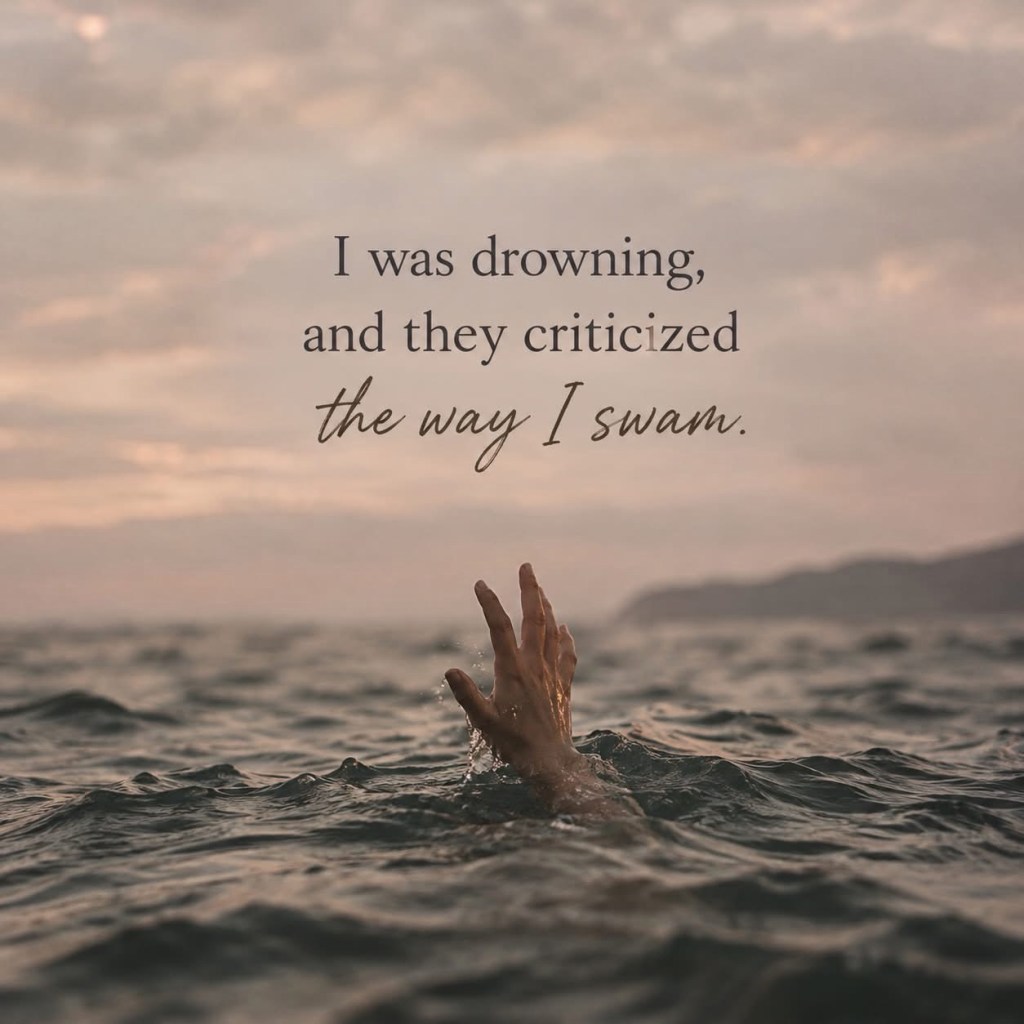
Here’s something brain imaging research has revealed about traumatic memory: when people relive a traumatic memory in a flashback, activity drops in Broca’s area — the part of the brain that turns thoughts into words — while regions associated with emotion and sensory memory become more active. That’s part of why trauma can feel “unspeakable”: in the moment of recall, the verbal, sequencing side goes quiet and the sensory-emotional side takes over. (Roughly speaking — the brain’s speech center sits mostly on the left, but memory, intuition, and reasoning all use both sides working together, not one hemisphere acting alone.)
That’s why the best thing you can do in the moment — when you have time, like hearing of a loved one’s death or receiving a difficult diagnosis, rather than in immediate physical danger — is give your nervous system a different signal. Slow down, and get the mind and heart working together again.
The practice
Slow your breathing: five seconds in through the nose, five seconds out through the mouth. As you breathe, place your hand on your heart — palm, fingers, prayer position, knuckles, whatever feels natural.
That pace — about six breaths a minute — has been shown in research to increase parasympathetic (vagal) activity, helping counterbalance the body’s stress response. Resting a hand on your heart simply gives your attention somewhere to land while you breathe.
This is a general wellness practice, not a medical treatment or a substitute for trauma therapy. If you have a heart or lung condition, check with your clinician first.

Why the heart matters
Researchers at the HeartMath Institute, drawing on the work of neurocardiologist J. Andrew Armour, describe the heart as having its own intrinsic nervous system — a network of roughly 40,000 neurons the Institute calls the “heart brain.” In HeartMath’s framing, this network processes information and signals the brain independently of conscious thought. (This is the Institute’s interpretation; mainstream neurocardiology describes the heart’s neural network primarily as regulatory circuitry.)
You’ve felt the disconnect. You can love and respect someone and know logically you should stay — yet feel no passion or connection. Or have nothing in common with someone and fall wildly in love. The heart and the logic brain are not the same instrument.
In the HeartMath Institute’s research program, the emotional states most associated with heart-brain coherence — measured through heart-rate-variability patterns — include caring, appreciation, gratitude, and compassion.
What did their research find? In one small HeartMath study of 30 people, five minutes of intentionally feeling care and compassion produced an immediate average 41% rise in salivary IgA, a frontline immune antibody — the lift faded within an hour, though it trended upward again over the next six. Strikingly, the same study found the immune-dampening effect of five minutes of anger lasted up to six hours. (A small, in-house, preliminary study — not a large clinical trial.)

The takeaway
Thoughts and beliefs trigger emotions, and emotions trigger responses. When the heart and mind are connected, intuition clears up and snap decisions start aligning with your values instead of your fears. That’s where healing begins — not in reliving the trauma, but in giving your nervous system a different signal.
I use this practice to open every session of my trauma-informed self-discovery group, before we do any deeper work. Five minutes. Your hand, your breath, your heart. You can do this anywhere, anytime.
Sources: van der Kolk & Fisler, summary of PET findings on traumatic memory; NYAS review of traumatic-memory neuroimaging (PDF); Nielsen et al. (2013) via University of Utah, No evidence for right-brained vs. left-brained people; HeartMath Institute, Science of the Heart research index and coherence pamphlet (PDF); Rein, Atkinson & McCraty (1995), The physiological and psychological effects of compassion and anger, J Advancement in Medicine; HeartMath, on immunity and positive emotion; resonance-frequency breathing assessment; Laborde et al. (2022), systematic review and meta-analysis of voluntary slow breathing, Neuroscience & Biobehavioral Reviews; Teicher et al., childhood maltreatment and corpus callosum review.


Thank you for stopping by. We hope you enjoyed the content. Feel free to share what brought you here and how we can support you. (Rude comments will be removed).
You must be logged in to post a comment.